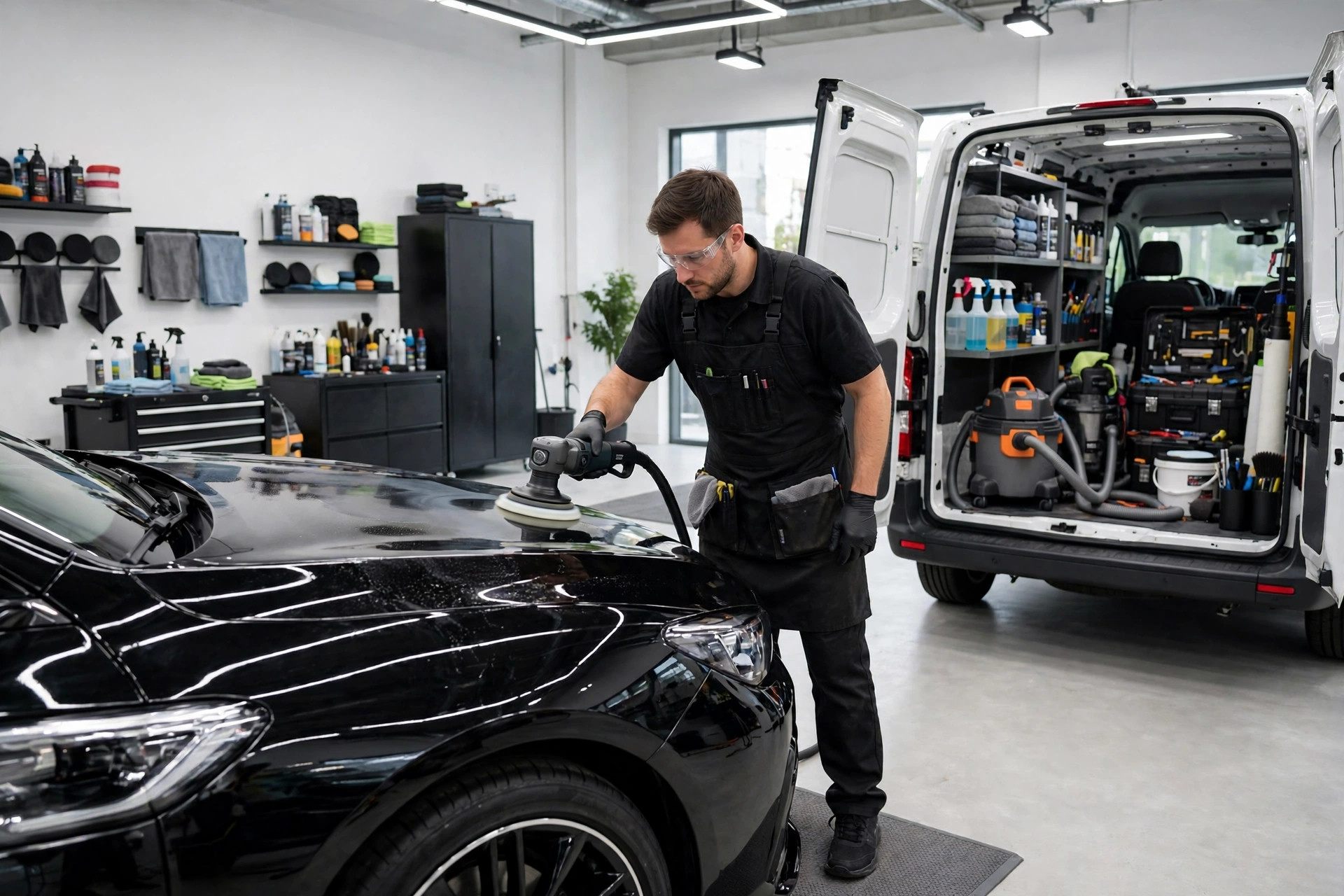
Auto detailing looks like a simple trade from the driveway — a van, a pressure washer, a gleaming car — but the business underneath splits into two very different models: a mobile rig that goes to the customer, and a fixed shop that the customer comes to. The mobile model starts for a few thousand dollars and lives or dies on route density and repeat bookings; the shop model starts for tens of thousands and lives or dies on rent and throughput. This guide covers what auto detailing businesses actually borrow for, what opening, growing, or equipping one costs in 2026, and which product fits each need.
The funding map for a detailing business splits into five buckets: equipping the first rig or shop, covering the gap between booking and payment, adding a second rig or a crew, carrying insurance and compliance costs, and buying the van or the shop build-out. Each bucket has a different best product, and the single most important underwriting fact in all five is that detailing is a cash business with thin fixed costs — the product has to match the gap, not just the amount.
What auto detailing businesses borrow for
The first rig. The most common first funding need. A lean mobile setup using a personal vehicle runs $3,000 to $5,300 in published 2026 guides, including working capital reserves. Outfitting a dedicated commercial van or trailer with commercial pressure washers, generators, and extractors runs $8,050 to $15,100, and a professional-grade start — used van, commercial equipment, branding, insurance — lands at $13,050 to $27,000. The rig is the business: a failed pressure washer on a customer's $90,000 SUV is a reputation problem, not just a repair bill.
Vans, trailers, and the shop. The capital-heavy route. A reliable used van or truck suitable for mobile detailing runs $15,000 to $35,000, new vans $30,000 to $50,000, and leasing runs $300 to $600 a month with a minimal down payment. A shop-based detailing business costs $15,000 to $55,000 or more to start — which is why most operators validate the mobile model first and let the shop follow the customer base rather than precede it.
Booking float and slow weeks. Detailing is weather-dependent and seasonal: winter slows exterior work in cold markets, rain kills a mobile route day, and a cancelled route is a crew paid for a day with nothing to bill. A working-capital line sized to the average month — published monthly overhead for a mobile operator runs just $430 to $1,300 — carries the business through a slow fortnight without touching the equipment budget.
Insurance, licensing, and compliance. General liability plus garagekeepers coverage runs $1,000 to $2,200 a year in published 2026 breakdowns, with a commercial auto endorsement adding $700 to $1,600. Garagekeepers matters specifically: it covers customers' vehicles in your care, custody, and control — the exact exposure a detailer carries all day. Add local rules on wash-water discharge and recovery, which can require containment equipment before a route is legal in some jurisdictions.
A second rig or a crew. Scaling means a second van, a second set of commercial equipment, and a lead detailer who can run a route unsupervised. Published models put a two-to-three-unit operation at $15,000 to $50,000 a month in revenue against a solo operator's $3,000 to $8,000 — but the second rig's payroll arrives weekly while its bookings build over months, and that gap is the funding need.
What it costs to open or grow an auto detailing business in 2026
Published 2026 startup guides agree on the shape even when the totals differ: mobile is cheap, professional is moderate, shop-based is a different business. The table below separates the three launch models so the funding ask matches the model, not the dream.
Lean mobile (personal vehicle, first customers). $1,070 to $2,450 for a budget start, or $3,000 to $5,300 with working capital reserves: a consumer-grade pressure washer, a wet/dry vacuum, chemicals, towels, and branding. This model proves demand. It does not survive a commercial fleet contract — the equipment will fail on the schedule a fleet requires.
Professional mobile (dedicated van or trailer). $13,050 to $27,000: used van $10,000 to $20,000, commercial pressure washer $500 to $1,600, extractor and steam cleaner $800 to $2,000, water tank and pump $400 to $1,200, generator $500 to $1,000, polisher $300 to $600, plus insurance, branding, and launch marketing. A full turnkey configuration with a new cargo van, secure upfit, wastewater recovery, and a deep reserve is modeled at up to $100,000 to $150,000 — the top of the range, not the entry point.
Fixed shop. $15,000 to $55,000 or more to start: lease deposits, build-out, wash bay, lighting, extraction, and signage, on top of the equipment above. Rent converts detailing's best advantage — near-zero fixed costs — into a monthly obligation that has to be fed whether or not it rains. Open the shop when the route book proves the demand, not before.
The per-car math funders check. Published 2026 pricing puts a basic wash at $50 to $100, a full detail at $150 to $300, and a premium detail at $300 to $500. One planning model uses $205 in net revenue per completed vehicle and three vehicles per field day for a mature single route — about $13,315 a month on a five-day week. Two $300 full details a day, five days a week, is $12,000 in gross monthly revenue in another published example. The numbers differ by market and mix; the discipline is the same: price per car, cars per day, days per week, and the travel and setup time between them.
Which product fits which need
Working capital advance or line of credit — the float. Best for slow weeks, seasonal gaps, and the second rig's startup months. Size it to the average month's gap — a few thousand dollars, not a round-number lump sum — and keep the surge capacity in a line that revolves. A line drawn only in slow weeks is worth more than a lump sum that sits idle in busy ones.
Equipment financing — the rig and the van. Best for vans, trailers, commercial washers, extractors, and steam cleaners. The equipment secures the loan, terms follow the asset's life, and financing typically requires 10 to 20 percent down spread over 3 to 5 years for a vehicle. A used van at $15,000 to $35,000 with a documented service history is often the best value in the fleet.
Term loan — the shop, the second location, the fleet. Best for planned, one-time investments repaid on a fixed schedule: a shop build-out, a second and third rig launched together, a fleet contract's startup months. SBA loans fit here too, for larger, longer-horizon investments — but they take weeks to months, so they are the wrong tool for a broken extractor on a Monday morning.
Merchant cash advance — the emergency only. Fits card-heavy businesses that need money in days. Mobile detailers increasingly take cards and subscriptions, so an advance can fit a genuine emergency — but daily debits against a weather-dependent route are a mismatch in a rainy month. If an advance is the only product that fits the timeline, size it to the specific gap and get the total repayment dollars in writing first.
How funders underwrite a detailing business
Deposits, not bookings. Average monthly deposits over the last 3 to 6 months, and their consistency, dominate the decision. A booking calendar full of no-shows is not revenue; deposits are. Memberships and fleet contracts help enormously here — recurring, contracted deposits underwrite far better than one-off residential jobs, which is why published guides report repeat rates of 60 to 80 percent for operators who build a book rather than chase single jobs.
Route density and the travel clock. Four to six cars a day is the published path to $10,000 months, but only if travel, setup, and pack-down time are counted. A route spread across a metro area spends its margin in the windshield. Funders who know mobile services ask about the service radius, the average ticket, and the repeat rate — the three numbers that decide whether the second rig pays for itself.
Seasonality and the winter plan. Exterior work slows in cold markets, and a mobile operator without interior, ceramic-coating, or fleet work to fill winter weeks has a predictable hole in the calendar. The honest answer funders want is a reserve built in the busy season, or a line drawn only in the slow months — not a hope that winter will be mild.
Concentration and custody. One dealership or fleet supplying most of the work is a concentration risk funders price in. And the custody exposure is real: a detailer holds customers' vehicles all day, so garagekeepers coverage and a clean claims history are part of the underwriting file, not just the insurance file.
Comparing offers without getting burned
Total repayment dollars, always. Always get the total repayment dollars in writing before you sign — not just the factor rate or the monthly estimate. Two offers with the same advance amount can differ by thousands in total repayment, and the difference is pure cost.
Match the payment rhythm to the collection rhythm. Daily debits fit daily card sales. Weekly or monthly payments fit subscription and fleet billing. A daily debit against a route that loses rainy days is a cash-flow mismatch that will show up in the statements within a month.
Watch the stack. A second advance on top of a first, without a payoff plan, is what breaks otherwise healthy operators. The combined daily debit, not either advance alone, is what the route's payroll has to survive.
Keep insurance and permits current mid-term. A lapsed garagekeepers policy or a discharge violation can void fleet contracts and trigger a funder review. Calendar every renewal and fund the premium before it is due, not after the cancellation notice.
What to do this week
Pull the last 3 months of business bank statements and read them the way a funder will: average monthly deposits, the biggest single deposit, the thinnest week, and every existing equipment payment. Then match the need to the product — float, rig, or shop — and get two quotes compared on total repayment dollars. The operator who knows the gap in dollars, and the route math that created it, negotiates from strength; the operator who asks for a round number negotiates from hope.
Frequently asked questions
How much does it cost to start a mobile detailing business?
A lean mobile setup using a personal vehicle runs 3,000 to 5,300 dollars including working capital reserves. A professional start with a dedicated van or trailer and commercial equipment lands at 13,050 to 27,000 dollars.
What equipment do auto detailing businesses finance most often?
Vans and trailers first, then commercial pressure washers, extractors, steam cleaners, water tanks, and generators. Equipment financing fits all of them because the machine itself secures the loan.
Do auto detailing businesses need bank statements to get funded?
Yes — your last 3 months of business bank statements are the core document, because funders underwrite from deposits. A photo ID and a voided check are optional, not required.
How much does a full detail cost in 2026?
Published 2026 pricing puts a basic wash at 50 to 100 dollars, a full detail at 150 to 300 dollars, and a premium detail at 300 to 500 dollars. Route density and repeat bookings decide whether those prices become steady monthly deposits.
Should a detailer open a shop or stay mobile?
Stay mobile until the route book proves the demand. A shop costs 15,000 to 55,000 dollars or more to start and converts detailing's best advantage, near-zero fixed costs, into rent that must be fed whether or not it rains.
Adding a rig, a van, or a second crew? See what you qualify for
From the first mobile rig to the fixed shop — get a no-obligation quote from our #1-ranked lender, Coast to Coast Fast Funding. One application reaches multiple funders, so you see the actual market for your file.
Apply Now →Soft credit check · 60-second pre-qualification