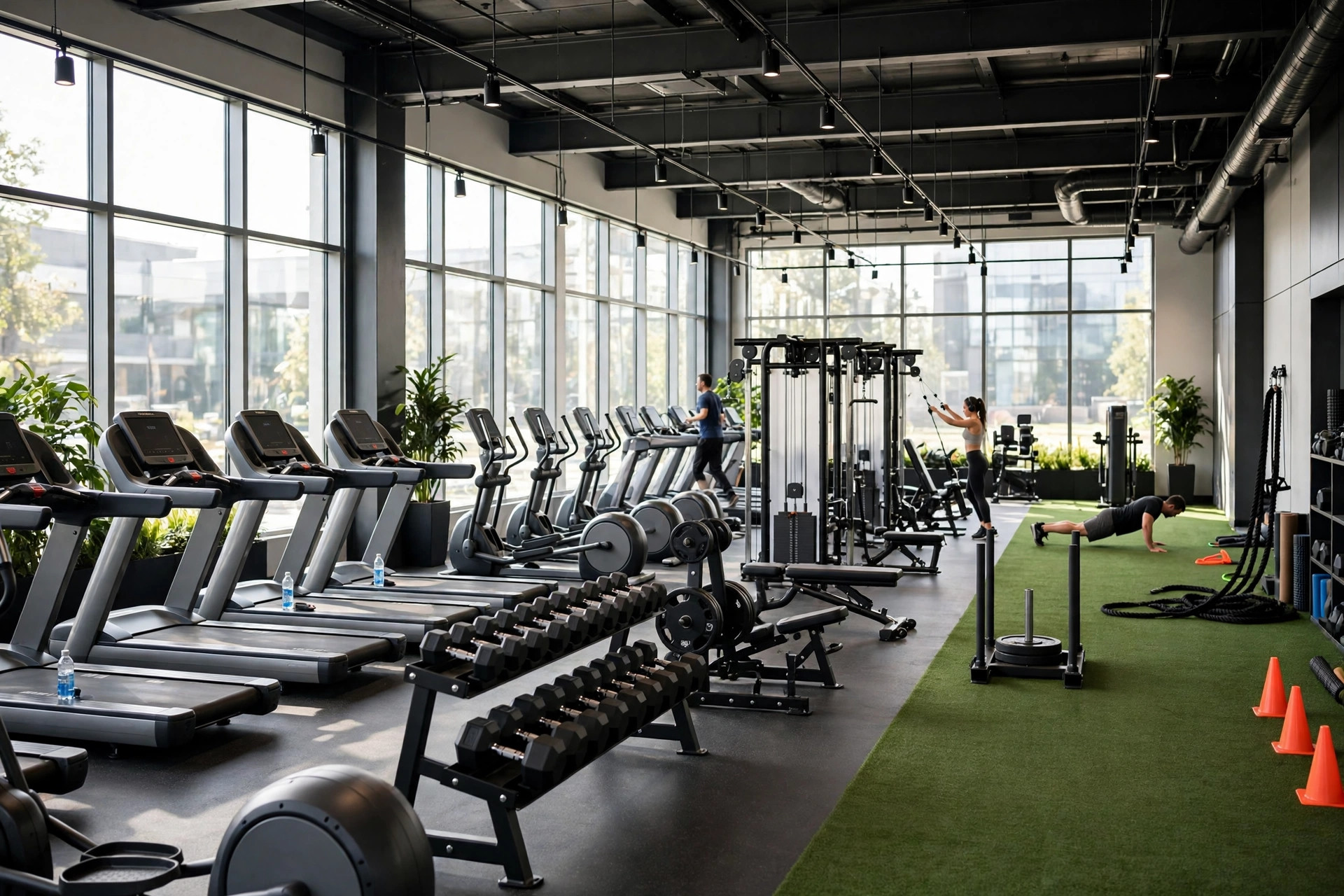
A gym sells a promise paid for monthly — and it buys almost everything up front. The lease is signed, the build-out is finished, and the equipment is on the floor months before membership dues add up to a real revenue line. That timing gap is the whole funding story for gyms and fitness centers: heavy upfront capital, recurring revenue that builds slowly, and a seasonal swing that can empty the floor in July just when rent is still due.
Funders know the pattern. They are not asking whether fitness is a good business — with roughly 81 million Americans belonging to a gym or studio in 2025, the demand is clearly there. They are asking whether your gym's monthly dues cover rent, payroll, and debt service with room to spare, and whether you have a plan for the months when they don't. This guide covers where gym money actually goes, which product fits each need, and what underwriters weigh on a fitness file.
Where the money actually goes in a gym
The equipment package. The single biggest upfront check for most gyms. Published 2026 build-out guides put typical ranges at roughly $15,000 to $50,000 for strength equipment (racks, barbells, dumbbells, selectorized machines), $20,000 to $75,000 for cardio (treadmills, bikes, rowers), and $10,000 to $40,000 for specialty gear (rigs, reformers, martial-arts mats), plus $2,000 to $10,000 in accessories and $3,000 to $10,000 for front-of-house gear. Individual machines vary widely: new commercial treadmills commonly run $3,000 to $8,000 each, while refurbished commercial units often sell for 30% to 60% less. A boutique studio's package looks nothing like a big-box club's — and funders will ask which model you are before they ask what you need.
Build-out and tenant improvements. Flooring that survives dropped barbells, showers and locker rooms, HVAC sized for a room full of people exercising, mirrors, sound, lighting, and the turf zone that every modern gym seems to want. Build-out is where budgets blow out: landlords offer tenant-improvement allowances, but they rarely cover the full scope, and the gap comes out of your capital. This is the cost category most likely to need long-term money rather than a short-term advance.
Rent during the ramp. Most gyms sign a lease and pay rent for months while membership is still building. The pre-sale period helps — selling founding memberships before opening day — but pre-sales rarely cover the full ramp. Budget for rent with thin dues revenue for the first several months, not just the opening month.
Payroll and programming. Trainers, front-desk staff, and class instructors are the product for boutique and class-based gyms, and a meaningful fixed cost even for open-gym models. Group fitness drives retention — members who take classes stay longer — but instructors get paid whether the class has four people or forty.
Marketing and member acquisition. The January wave does not arrive on its own. Pre-sale campaigns, local partnerships, and digital ads are a real line item, and the cost to acquire each member has to be repaid out of months of dues — which is why retention, not sign-ups, is the number funders watch.
The membership math — a worked example
Put numbers on it. Say a neighborhood gym has 300 members paying $50 a month. That is $15,000 a month in recurring dues revenue (illustrative math — your dues, member count, and churn set your number). Against that, suppose rent is $6,000, payroll $5,000, and other operating costs $2,000 — $13,000 out, leaving $2,000 a month before debt service. A $1,500 monthly loan payment fits; a $4,000 one does not, no matter how good the equipment looks on the floor.
Now run the seasonal version. Industry data puts roughly 12% of all annual gym sign-ups in January alone, and summer months see a spike in cancellations as members travel and school breaks disrupt routines. If that same gym loses a net 10% of members over the summer — 30 members, $1,500 a month in dues — the $2,000 cushion shrinks to $500 before debt service. That is the month the line of credit earns its keep, and the reason funders ask about your summer plan, not just your January numbers. Our working-capital sizing guide shows how to run this for your own member count and dues.
Which product fits each gym need
Equipment financing — the machines. The equipment itself serves as collateral, which can mean faster approval and less emphasis on your credit history. Terms typically track the useful life of the equipment. This is the cleanest fit when the purchase is almost entirely machines — a cardio refresh, a new strength line, a turf install. Watch the match: financing a treadmill over a term longer than its useful life leaves you paying for equipment members have already stopped using.
SBA 7(a) — the build-out or the whole project. The long-horizon play for a new location, a major renovation, or buying an existing gym. Standard 7(a) loans go up to $5 million and can fund build-out, equipment, and working capital together, with terms up to 10 years for equipment and up to 25 years when real estate is included. The trade-off is time: expect a detailed application, a business plan, and weeks to months to close. Start this one before you sign the lease if you can. See our MCA vs. SBA loan comparison for the full trade-off.
Term loan — the defined project. A fixed amount on a fixed horizon, matched to a second location, a studio conversion, or a known equipment refresh cycle. Faster than SBA, slower than an advance, and priced for a project with a clear payback.
Business line of credit — the seasonal swing. Draw in the summer dip, repay in the January surge. This is the product built for the gym calendar: it covers the months when dues dip below fixed costs without turning a seasonal gap into permanent debt. The discipline: repay it when the surge arrives, don't let it become the rent payment.
Fast daily products — the genuine emergency only. A build-out overrun or a broken HVAC system days before opening are real emergencies. But daily debits against monthly dues revenue are a mismatch: the debits come out every business day while your members pay once a month, so a slow summer can leave the account short for rent while debits continue. Use them for a real, short window with a clear payoff plan — never as the plan for rent or payroll.
Franchise vs. independent — what changes on the file
Franchise gyms usually fund more easily. The lender can underwrite a known brand, a standard build-out cost, and comparable unit economics from other locations — and SBA lenders are familiar with franchise systems. The cost side is real, though: franchise fees, ongoing royalties, marketing-fund contributions, and required vendors all raise your fixed monthly costs, which shrinks the dues cushion in the worked example above. Funders will want the Franchise Disclosure Document and the franchisor's financials in the file. Our franchise funding guide covers the full picture.
Independent gyms keep every dollar of margin and full control over programming, pricing, and branding — but the lender is underwriting you and your local market alone. A stronger business plan, evidence of pre-sales or existing membership, and more owner equity in the project all matter more. Boutique concepts (Pilates, boxing, HIIT studios) often have an easier story here: smaller spaces, lower equipment bills, and class-based revenue that funders can model per-class rather than per-member.
What funders actually weigh on a gym file
Recurring revenue vs. fixed costs. The core ratio: monthly dues against rent, payroll, and debt service. Funders want to see dues covering fixed costs with room to spare — and they will stress-test it against a summer dip, not just your best month.
Retention and churn. Industry benchmarking puts average annual member retention around 66%, meaning roughly one in three members leaves each year. Boutique studios tend to retain better than big-box clubs. If your churn is worse than the benchmark, funders will ask why — and your answer should be programming and onboarding, not discounts.
Lease terms. Length, renewal options, rent escalations, and any personal guarantee on the lease all land on the file. A five-year lease with steep annual escalations and no renewal option is a risk flag, because the loan may outlast your right to the space.
Owner experience and equity. Prior fitness-industry experience, a credible business plan, and real owner cash in the project. For a new gym, the owner's equity contribution is often the difference between an SBA approval and a decline.
Bank statement health. Consistent deposits, no chronic overdrafts, no unexplained gaps. For an existing gym, the last three to six months of the operating account — showing dues deposits arriving on schedule — are the standard evidence.
What to have ready when you apply
Gym applications move fast when the paper trail is ready. Before you apply, assemble: three to six months of business bank statements; your lease (or letter of intent) and build-out quotes; an equipment list with vendor quotes; your membership count, dues rate, and churn history if operating; a business plan with your ramp assumptions for a new gym; and the owners' personal credit picture. Franchise buyers should also have the Franchise Disclosure Document ready. Questions about your file? Call (352) 809-3201.
Mistakes that sink gym funding plans
Financing equipment over a term longer than its useful life. Paying for treadmills members stopped using two years ago is how gyms end up cash-poor with a full floor.
Spending the January surge. The year's biggest dues month is not profit — it is the cushion for the summer dip. Bank it, don't spend it on a premature expansion.
Under-budgeting the build-out. The tenant-improvement allowance rarely covers the full scope. Price the gap before you sign, not after the contractor starts.
Funding rent with daily-debit products as the plan. Monthly dues in, daily debits out — the mismatch compounds in slow months. A line of credit fits the gym calendar; daily debits fight it.
Pricing for sign-ups instead of retention. A $10-a-month plan that churns in three months is worth less than a $50 plan that stays for two years. Funders model lifetime value, and so should you.
Signing a lease before the funding is lined up. Rent starts whether or not the loan closes. Get the SBA or term loan moving before the lease clock does.
Frequently asked questions
How much does it cost to equip a new gym?
It depends on the model, but published 2026 build-out guides put a typical equipment package in broad ranges: strength equipment roughly $15,000 to $50,000, cardio roughly $20,000 to $75,000, specialty gear such as rigs or reformers roughly $10,000 to $40,000, plus accessories and front-of-house gear. A boutique studio needs far less than a full-service club. Used commercial equipment often sells for 40% to 60% of retail, which is why many first-time owners mix new cardio with refurbished strength pieces.
Is equipment financing or a term loan better for gym equipment?
Equipment financing uses the machines themselves as collateral, which can mean faster approval and less reliance on your credit history — but the loan is tied to that equipment. A general term loan gives you flexibility to cover equipment plus build-out and working capital in one package, at the cost of a broader underwriting review. If the purchase is almost entirely machines, equipment financing is usually the cleaner fit; if you are also funding a build-out, a term loan or SBA loan usually covers more of the project.
Can a new gym with no operating history get an SBA loan?
Yes, but it is the slowest path. SBA 7(a) loans go up to $5 million and can fund build-out, equipment, and working capital, with terms up to 10 years for equipment and up to 25 years when real estate is included. New gyms typically need a detailed business plan, personal financial statements, and an equity contribution, and should expect weeks to months from application to funding. A franchise with a proven model can be easier to underwrite than an independent concept with no track record.
How do gyms handle the January surge and the summer dip?
January brings the year's biggest wave of sign-ups — industry data puts roughly 12% of annual sign-ups in January alone — while summer months see a spike in cancellations from travel and school breaks. Smart operators treat January dues as a windfall to bank, not spend: they pre-sell annual memberships in November and December, sell class packs and personal-training packages that survive the summer, and keep a working-capital cushion sized for two to three slow months.
Are daily-payment advances a good fit for a gym?
They can work for a genuine short-term need, but they are risky as a standing plan for a membership business. Daily or weekly debits pull from the same account that collects monthly dues, so a slow summer month can leave you short for rent and payroll while debits continue. They make most sense for a defined, short window — a build-out overrun or a one-time equipment purchase — with a clear payoff plan, not as permanent working capital.
Franchise or independent — which is easier to fund?
A franchise usually funds more easily because the lender can underwrite a known brand, a standard build-out, and comparable unit economics — but franchise fees, royalties, and required vendors raise your fixed costs every month. An independent gym keeps full control and keeps every dollar of margin, but the lender is underwriting you and your local market alone, so a stronger business plan and more owner equity matter. Either way, funders weigh the same core question: does monthly recurring dues revenue cover rent, payroll, and debt service with room to spare?
January surge coming — or summer dip ahead? See what you qualify for
From the equipment package to the build-out to the seasonal swing — get a no-obligation quote from our #1-ranked lender, Coast to Coast Fast Funding. One application reaches multiple funders, so you see the actual market for your file. Questions? Call (352) 809-3201.
Apply Now →Soft credit check · 60-second pre-qualification · (352) 809-3201