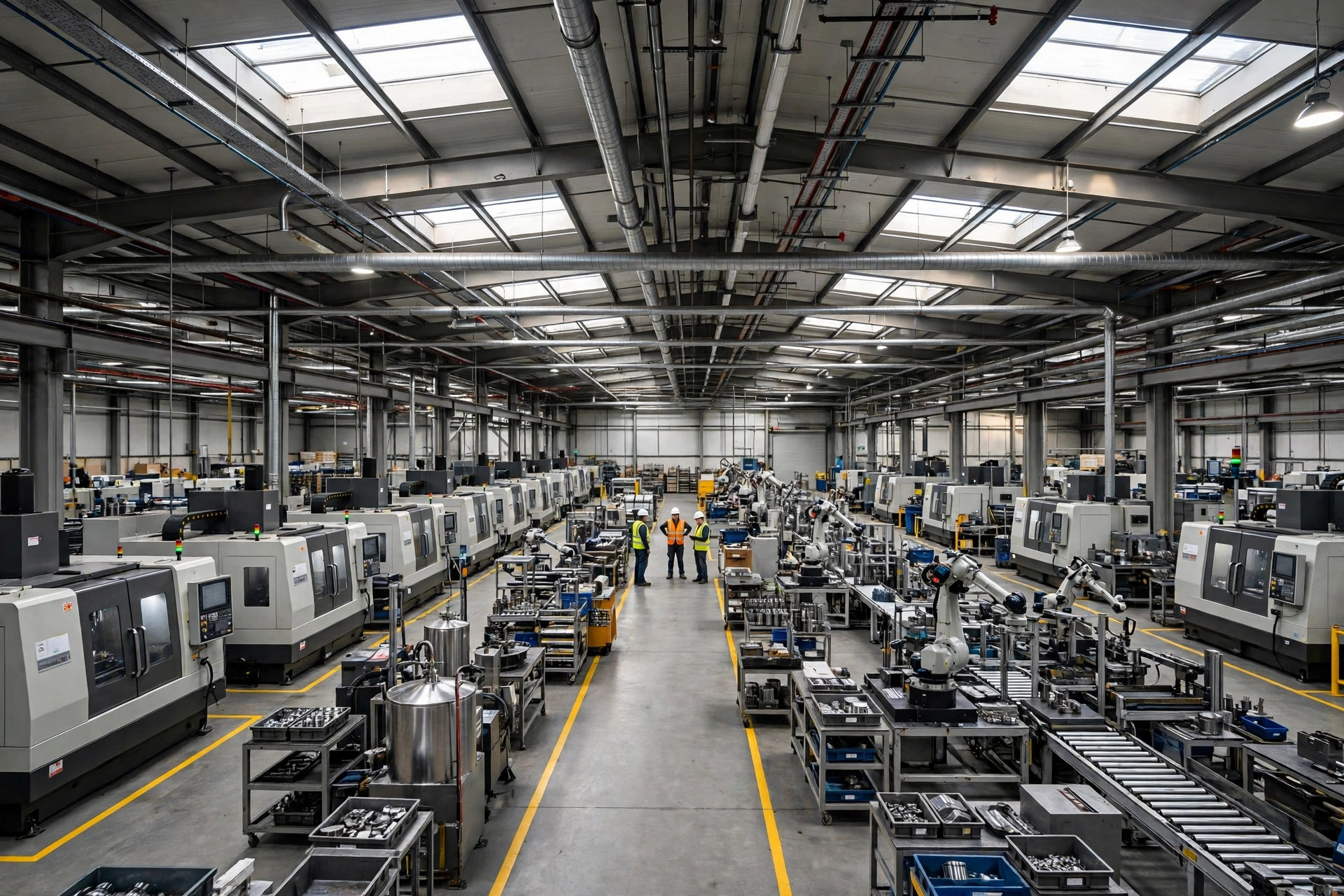
A manufacturer spends first and gets paid last. The steel, the resin, the components get ordered and paid for today; the CNC machine gets installed next month; the first finished unit ships in ninety days; the customer pays on net-60 after that. Every order is a cash-flow trench you dig before you climb out of it — and underwriters who only see monthly deposits miss how the business actually breathes.
Manufacturing is one of the few industries where the assets do half the underwriting work for you. Machines, inventory, purchase orders, and receivables are all financeable on their own merits, and SBA programs treat manufacturers better than almost any other vertical. This guide covers where plant money actually goes, which products fit each need, and the qualification reality behind the marketing.
Where the money actually goes in a manufacturing company
Machines and equipment. CNC centers, presses, robotics, tooling — a single machining center can cost more than a year's payroll. This is the biggest capital outlay most manufacturers ever make, and it is the one use where equipment financing beats every general-purpose product on the menu: the machine secures the deal, terms are matched to its useful life, and payments are usually monthly, not daily.
Raw materials and bulk purchasing. Buying steel, resin, or components at volume locks in pricing and keeps the line running — but it means six figures of material sitting in the warehouse before a single unit ships. A line of credit drawn for the material buy and repaid as orders ship is the classic shape for this need.
The facility itself. Buying the plant, expanding it, or outfitting a new line. Owner-occupied industrial real estate is SBA bread and butter — 7(a) covers it up to $5 million, and 504 goes higher per project for manufacturers — with terms measured in decades, not months.
Skilled labor and payroll. Machinists, operators, and engineers are the industry's scarcest resource, and they expect pay every two weeks whether the big customer has paid yet or not. Funding that keeps payroll whole between production and payment is one of the highest-ROI uses of capital in the business.
The big-order trench. Landing a contract with a Fortune 500 buyer is the best news and the worst cash-flow event in the same email: you now need to produce at a scale your working capital was never sized for. Purchase-order financing exists for exactly this — it pays your suppliers directly against the confirmed order so you can fulfill it.
Seasonal and cyclical swings. Construction-adjacent manufacturers build in winter for spring delivery; food-packaging plants surge ahead of holidays. A business that is full in November and empty in February has a timing problem, not a failing model — and the cash cushion that carries it is legitimate working-capital use.
The qualification reality
Marketing says "all manufacturers qualify." Underwriting says: show me the assets and the statements. Here is what funders actually weigh:
Time in business and order history. The biggest single factor. A shop with five years of steady purchase orders and clean statements gets real options; a six-month-old shop gets expensive ones. Most fast-funding products want to see at least several months of operating history; SBA products want a couple of years.
Bank statement health. Underwriters read the operating account: average daily balances, deposit consistency, NSF frequency. The material-buy-to-payment gap is normal in this business; erratic deposits plus NSFs is not. Know what underwriters look for, then make sure three months of statements tell the real story.
Customer quality and contracts. This is where manufacturers have an edge most businesses do not: a signed purchase order from a creditworthy buyer is fundable on its own. Long-term contracts, recurring orders, and creditworthy customers all strengthen a file — and they are the entire basis of PO financing and factoring.
Equipment and real estate as collateral. Machines with long useful lives and owner-occupied industrial property give lenders something to secure against. Lenders typically want equipment useful life at least as long as the loan term — a ten-year machine supports a ten-year note, and that match is what keeps payments manageable.
Equipment financing vs MCA: the machine question
This is the single most consequential product decision a manufacturer makes. When the need is a named piece of equipment, equipment financing wins on almost every axis: the machine secures the deal so terms reflect the collateral, payments are usually monthly and matched to the equipment's working life, and it leaves your general credit capacity free. A merchant cash advance with daily debits against cyclical manufacturing revenue is the wrong shape for a twenty-year machine — speed is what an advance is for, not hardware.
The practical rule: if you can name the machine, the invoice, and the useful life, finance the machine. If the need is the material buy or the payroll bridge while you wait on a customer's payment, that is a working-capital product, not an equipment one.
Which product fits which need
Equipment financing — for machines and tooling. The home turf of this product: the CNC center, the press, the robotics cell secure the deal, terms reflect the collateral and the useful life, and payments are monthly. Even challenged credit can often get equipment financed, because the collateral does the talking.
SBA 7(a) — for the plant, big equipment, and working capital. Up to $5 million for owner-occupied industrial real estate, equipment, and working capital — with equipment and working-capital terms up to 10 years and real estate terms up to 25. Typical qualification: a couple of years of history, strong credit, and debt service coverage around 1.15x to 1.25x. The cost is a longer underwriting timeline — plan for weeks, not days.
SBA 504 — for real estate and heavy equipment. This is the program that treats manufacturers best: higher per-project limits for manufacturers ($5.5 million per project), manufacturers can use 504 across multiple distinct projects, and manufacturing NAICS codes had guarantee fees waived in FY 2026. If the project is the building or the long-life equipment, 504 is the first conversation.
Purchase-order financing — for the big contract. Pays your suppliers directly so you can fulfill a confirmed order you could not otherwise afford to produce, repaid when the customer pays. Built for one big order at a time — not for general working capital, and the customer has to be creditworthy.
Invoice factoring — for net-30 to net-90 waits. Advances cash against invoices to creditworthy commercial customers while you wait out their payment terms. One of the most natural products for manufacturers, because the collateral is the invoice itself, not your credit score.
Business line of credit — for materials and seasonal swings. Draw for the material buy, repay as orders ship, pay for what you use. For the permanent working-capital drag of inventory and cyclical payroll, nothing matches the cash-flow shape better — but lines are harder to qualify for than advances, so they reward the established shop.
Merchant cash advance — for genuine time pressure. The material shipment is held at the dock, payroll is Friday, the customer's wire is next week. An advance is the fastest money available, and speed has real value when the line has to keep running. The discipline: use it for the sprint, not the marathon — and never stack a second advance to service the first, because cyclical manufacturing revenue cannot survive daily debits on two fronts.
Manufacturing red flags
Financing the machine with daily debits. A long-life machine bought with a short-term advance is the most expensive version of every mistake: the payments do not match the asset, the cost compounds, and the machine that was supposed to generate revenue becomes the reason it stops.
Financing against hoped-for orders. PO financing works on signed purchase orders from creditworthy customers. A verbal commitment, a bid you "should" win, or a forecast is not a purchase order — and any financier who funds on one is pricing for the risk of you being wrong.
Factoring concentration. If one customer is 80 percent of your invoices, you have a customer problem wearing a factoring solution. Financiers discount concentrated books, and a single customer's slow pay or dispute can freeze your whole cash advance line. Diversify the book before you factor it.
"Guaranteed approval" ads. No legitimate funder guarantees approval — the phrase is a lead-generation hook, and the product behind it is usually the most expensive one on the menu. Real qualification takes statements and underwriting, even for plants with eight-figure revenue.
Getting ready to apply: the checklist
Funding-ready checklist
- Last three months of bank statements from the company's operating account — the standard ask
- Clean banking history: no recent NSFs, consistent deposits, balances that don't scrape zero
- Signed purchase orders or customer contracts if seeking PO financing or factoring
- Equipment quotes or invoices with specs and useful-life estimates if financing machines
- Time in business and monthly revenue figures you can back up with the statements
- Accounts-receivable aging report — shows underwriters who owes you and for how long
- Photo ID and a voided check available if a specific product's verification asks — not required upfront
Frequently asked questions
Can manufacturing companies get SBA loans?
Yes — manufacturing is one of the most SBA-favored industries. SBA 7(a) covers equipment, working capital, and owner-occupied industrial real estate up to $5 million, and SBA 504 covers real estate and equipment with higher per-project limits for manufacturers ($5.5 million) across multiple distinct projects. Manufacturing NAICS codes also had guarantee fees waived in FY 2026.
Should I finance equipment or take a cash advance to buy it?
Finance the equipment. When the need is a named machine, equipment financing wins on almost every axis: the machine secures the deal so terms reflect the collateral, terms are matched to the equipment's useful life (lenders typically want useful life at least as long as the loan term), and monthly payments fit equipment cash flow far better than daily debits. An advance is for speed, not for hardware.
What is purchase order financing?
Purchase order financing pays your suppliers directly so you can fulfill a confirmed customer order you could not otherwise afford to produce. The financier funds the production cost against a purchase order from a creditworthy customer and is repaid when that customer pays. It is built for one big order at a time — not for general working capital.
Can a manufacturer get funding before the customer pays?
Yes. Invoice factoring advances cash against invoices to creditworthy commercial customers — typically while you wait out net-30 to net-90 terms. It is one of the most natural products for manufacturers because the collateral is the invoice itself, not your credit score.
Can a startup manufacturer get business funding?
It is harder without revenue history. Most funders want several months of bank statements with real deposits. A new shop's most realistic paths are equipment financing secured by the machine itself, PO financing against a signed order from a creditworthy customer, or operating on owner capital until statements exist. SBA products generally want a couple of years of history.
Do I need a voided check or photo ID to apply?
No. Applications run on bank statements — the last three months of the company's operating account are the standard ask. A voided check or photo ID is sometimes requested for verification on specific products, but neither is a universal requirement, and anyone demanding them upfront before showing you terms is a red flag.
New machine or big order on the books? See what you qualify for
Equipment, materials, the facility, or the big-order trench — get a no-obligation quote from our #1-ranked lender, Coast to Coast Fast Funding. One application reaches multiple funders, so you see the actual market for your file.
Apply Now →Soft credit check · 60-second pre-qualification