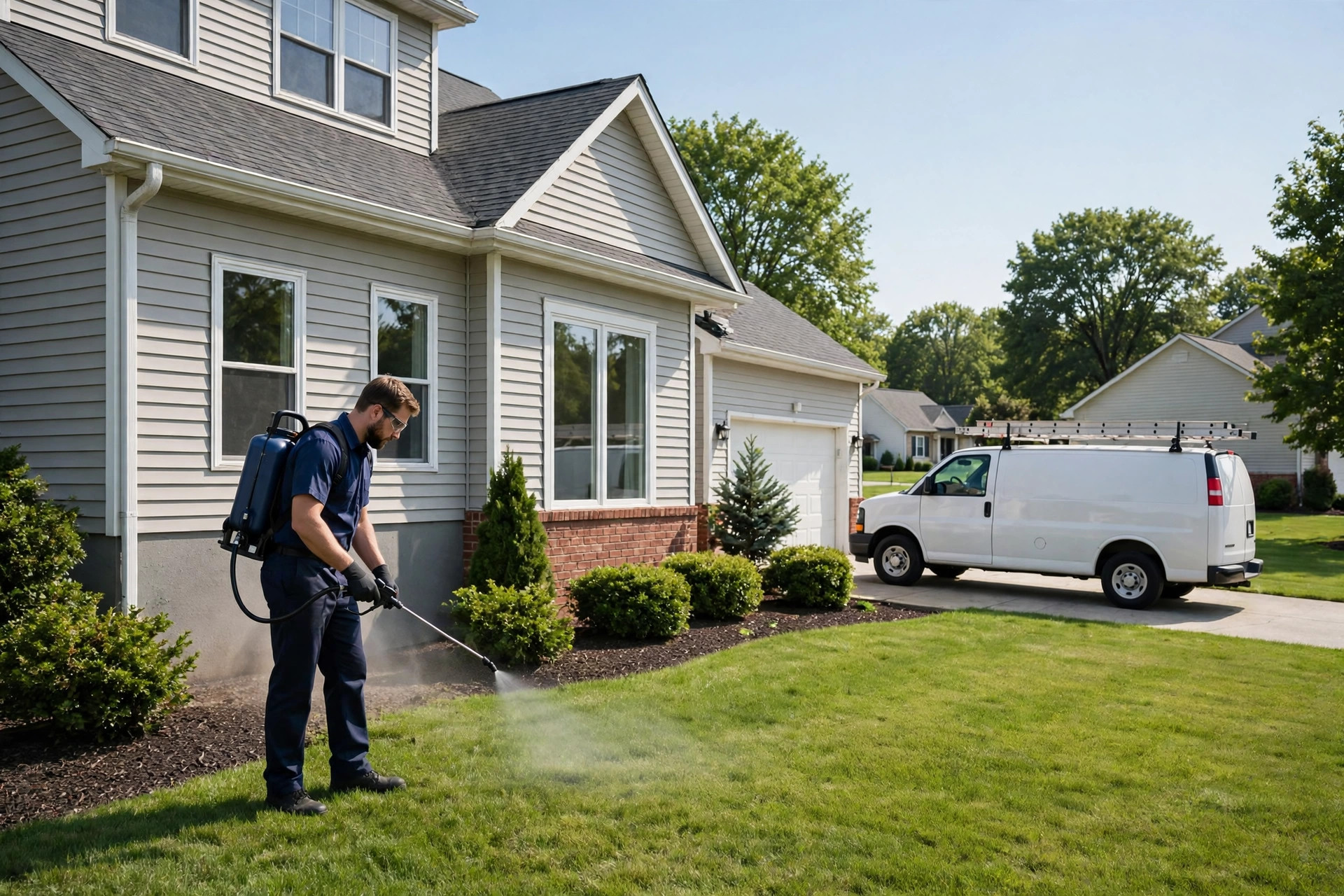
Pest control looks like a simple trade from the driveway — a van, a spray rig, a route sheet — but the business underneath is one of the most attractive in home services, because it is a subscription business with a steering wheel. Customers pay every month to never see a bug, and a route of recurring accounts is an asset that can be bought, sold, and borrowed against. This guide covers what pest control companies actually borrow for, what opening, growing, or buying a route costs in 2026, and which product fits each need.
The funding map for a pest control company splits into five buckets: opening a route, buying an existing route, equipping vans and technicians, expanding into high-margin specialties, and carrying the winter gap. Each bucket has a different best product, and the single most important underwriting fact in all five is the recurring book: funders value contracted, retained accounts very differently from one-time jobs.
What pest control companies borrow for
Opening a route. The most common first funding need. A solo operator can launch lean — published 2026 planning ranges put a single-truck startup at $10,000 to $50,000 depending on vehicle, equipment, licensing, and insurance — but the working-capital reserve for the first months, while the route fills, is what most plans underestimate. A revenue-based advance or line of credit sized to the ramp covers payroll, chemicals, and fuel until recurring billing catches up.
Buying an existing route. The growth shortcut. A route purchase buys a book of recurring service contracts in a tight territory — typically a few hundred accounts serviced on a weekly loop by one technician with one spray rig — plus the customers, the technician, and the reputation. Funding is usually a term loan underwritten on the route's historical collections, and the denser the route, the stronger the file: 20 to 30 stops a day in a tight loop beats a scattered book every time.
Vans, equipment, and technicians. The capital-heavy route. A used service van, the spray rig and buildout, inspection and trapping gear, and the safety stock of chemicals — plus the next technician's hiring and training — add up with every route added. Equipment financing fits the van and rig because the asset secures the loan; working capital covers the hiring lag, since a new technician bills fully only after training and route familiarity.
Specialty services. The margin expansion. Structural wildlife exclusion, thermal bed bug remediation, and subterranean termite barrier treatments are the highest-margin work in the trade — published ranges put these jobs at $500 to $3,500 per service at 50 to 70 percent gross margins — but they need specialized equipment, extra certification, and marketing to homeowners who do not yet know they need them. A term loan or equipment financing fits the buildout; the payback comes from the margin, not the volume.
The winter gap. The seasonal need every pest operator knows. Revenue drops 20 to 30 percent in winter in most markets, while the recurring base still needs servicing and the technicians still need paying. A line of credit sized to the slow months, repaid from the spring surge, is the right product — not a daily-debit advance sized to a summer peak.
What a pest control company actually costs in 2026
Published 2026 planning ranges anchor the conversation. Startup costs vary widely with vehicle choice and market, but the line items are consistent — and funders read them as a checklist, not a guess.
| Cost item | Published 2026 planning range | What drives it |
|---|---|---|
| Solo startup, all-in (without vehicle) | $5,000–$17,000 | Licensing, equipment, insurance, marketing |
| Solo startup, all-in (with used vehicle) | $20,000–$35,000 | Vehicle is the swing variable |
| Full launch with reserve (one van + staged second van) | $35,000–$310,000 | Reserve depth and facility breadth |
| Used service truck | $12,000–$28,000 | Age, mileage, condition |
| Vehicle buildout (rig, storage, signage) | $4,500–$11,000 | Rig type, tank size, shelving |
| Licensing and certification | $200–$1,000 | State exam and category fees |
| Chemical inventory, opening | $1,200–$3,500 | Service mix, storage compliance |
| Route software | $99–$399 per month | Seats, scheduling, billing features |
| Insurance (liability + auto) | $2,000–$7,800 per year | Coverage limits, fleet size, claims |
| Working-capital reserve | $18,000–$55,000 | Months of payroll, fuel, and chemicals before billing catches up |
| Specialty job (wildlife, bed bug, termite barrier) | $500–$3,500 per service | Scope, equipment, certification; 50–70% gross margins |
For the pest control company itself, the numbers that matter most are the recurring ones: industry data puts roughly 74 percent of pest control income in recurring revenue, with average gross margins near 58 percent across a national study of 246 companies, and annual retention above 90 percent with customer lifetimes of 7 to 10 years. A funder reading those numbers sees a book that renews itself — which is why a route with documented retention borrows better than a one-time-job business of the same size.
How a pest control company actually makes money
Recurring residential routes. The core. Homeowners pay monthly or quarterly for perimeter maintenance, and the route technician services 8 to 15 stops a day at 20 to 45 minutes per stop. Published residential pricing runs $75 to $150 per visit, and the economics improve with density: a tight loop of nearby accounts means more billable stops per hour and less fuel per dollar of revenue.
Commercial contracts. The scale revenue. Restaurants, warehouses, offices, and multifamily properties pay $200 to $500 per month for scheduled service, and a single commercial account can equal several residential ones. Funders like commercial books because the contracts are written, the billing is monthly, and the churn is lower — but they discount concentration, so a book dependent on one big account reads weaker than a diversified one.
One-time and specialty jobs. The margin revenue. Initial infestation treatments, termite barriers, bed bug heat treatments, and wildlife exclusion carry the highest single-service margins in the trade — and they convert: a one-time job handled well becomes a recurring account, which is why operators price the first job as an acquisition cost, not a profit center.
Service stacking. The growth lever. Termite, mosquito, and wildlife services sold onto the same customer relationship raise revenue per account without raising route cost much — the technician is already at the property. A company that stacks services grows revenue faster than headcount, and funders notice, because the margin expansion shows up directly in the bank statements.
Which product fits which pest control need
| Your need | Best first product | Why |
|---|---|---|
| Launch a route or cover the ramp | Revenue-based funding or line of credit | Funds in days; repay as recurring billing catches up |
| Buy an existing route | Term loan | The route's collections support a fixed payment over years |
| Service van or spray rig | Equipment financing | The asset secures it; payments match its useful life |
| Specialty equipment and certification | Equipment financing or term loan | High-margin work pays the loan back from the margin |
| Winter revenue gap | Line of credit | Draw for the slow months, repay from the spring surge |
| Hire and train technicians | Line of credit or revenue-based funding | Covers the training lag before new techs bill fully |
What funders weigh on a pest control file
The recurring book. Funders start with bank statements, but for pest operators they also read the route: accounts under contract, billing frequency, and retention. A book with 90 percent-plus annual retention and automated card billing reads as an annuity — and an annuity borrows better than a job shop.
Route density. Stops per day and miles per stop drive the margin. A dense route — 20 to 30 stops a day in a tight loop — converts deposits into profit far more efficiently than a scattered book, and funders who understand routes will ask about density before they ask about revenue.
License standing and compliance. Every state requires a pesticide applicator license, usually with annual renewal, and commercial structural work falls under EPA Category 7. A lapsed license or a compliance flag is a fast decline on any file. Keep licenses current and documented — funders ask, and a same-day answer speeds the approval.
Seasonality and the winter plan. Revenue drops 20 to 30 percent in winter in most markets, and funders price for it. A file that shows the winter plan — rodent services, commercial contracts, and a line of credit sized to the gap — reads as managed risk, not a surprise.
The documents: short list, no surprises
For a revenue-based application, the standard ask is short: last 3–6 months of business bank statements and a completed application. A government-issued ID and a voided check are sometimes requested for verification on specific products before funding — but neither is a universal upfront requirement to see your offers. Bank and SBA applications add tax returns, profit-and-loss statements, and often proof of licensing and insurance. If a lender asks for far more than this list for a small revenue-based advance, that is a sign to compare offers elsewhere.
Mistakes that cost pest control companies real money
Financing a slow winter with a fast product. Daily-debit funding is built for needs that generate cash quickly — a route purchase, a specialty buildout. Using it to cover a structural winter shortfall just stacks payments on top of a shortfall.
Signing on total repayment you never saw. Always get the total repayment dollars in writing before you sign — not just the factor rate or the monthly estimate. Two offers with the same advance amount can differ by thousands in total repayment.
Buying a scattered route. A route purchase priced on account count alone can disappoint: scattered accounts burn fuel and technician hours, and churn runs higher where service is inconvenient. Price the route on density and retention, not just headcount.
Underpricing the first job. A one-time treatment priced below cost to win the customer only works if it converts to a recurring account. Track conversion, not just job count — a cheap first job that never recurs is a loss, not a funnel.
Opening, buying, or growing a pest control route? See what you qualify for
From the first van to the tenth route — get a no-obligation quote from our #1-ranked lender, Coast to Coast Fast Funding. One application reaches multiple funders, so you see the actual market for your file.
Apply Now →Soft credit check · 60-second pre-qualification