What towing companies borrow for
Towing is one of the few trades where the truck is the entire business. A towing company borrows for five moments: the first truck, the second truck that lets the owner stop driving every call personally, the heavy wrecker that opens police-rotation and commercial work, the impound lot or yard, and the cash-flow gap when motor-club and municipal payments lag 30 to 60 days behind the fuel and payroll already spent. Each moment has a different right product, and the most expensive mistake in this trade is financing the wrong moment with the wrong product — usually a daily-debit advance against revenue that arrives in monthly batches.
What a towing business actually costs in 2026
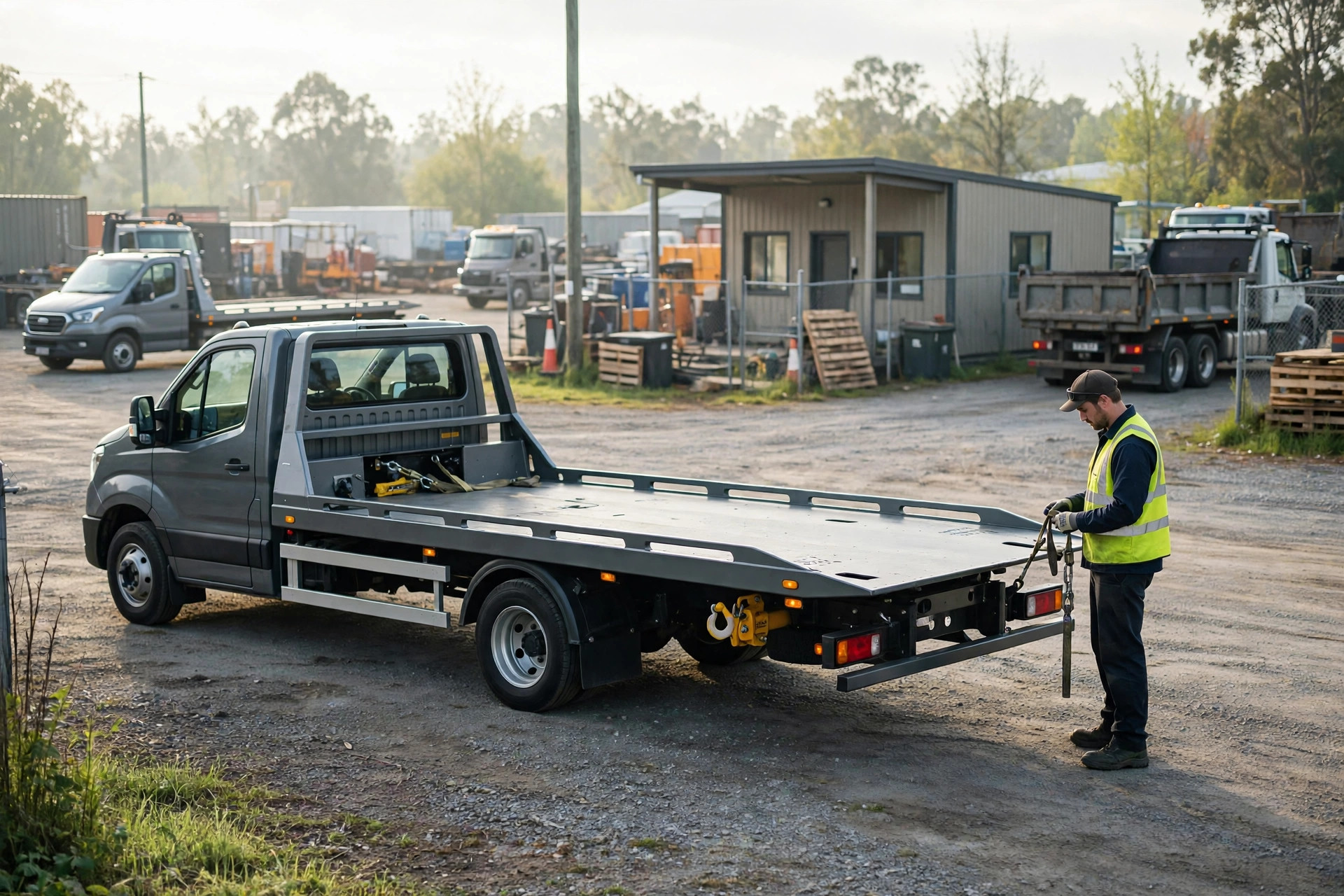
Published 2026 equipment guides put new mid-duty rollbacks (flatbeds) in the $95,000 to $160,000 range, with used flatbeds commonly running $30,000 to $80,000 depending on age, mileage, and condition. Light-duty wheel-lift trucks sit in a similar new range. Heavy-duty integrated wreckers run $200,000 to $650,000 new, and the largest rotators can exceed $1 million fully equipped. The price spread is the point: a one-truck roadside operation and a heavy-recovery company are different businesses with different capital needs, and funders price them differently. Beyond the truck, budget for commercial auto and on-hook/cargo insurance (often the second-largest fixed cost after the truck payment), fuel, dispatch software and radios, yard rent, and licensing and permits, which vary by city and county — some jurisdictions cap the number of tow permits or require specific equipment inspections before a company can join a rotation list.
How a towing company actually makes money
Revenue comes from four streams, and the mix decides everything about borrowing. Motor-club dispatches (AAA and similar networks) bring steady volume at contracted rates that leave little room to negotiate — the club sets the price, and the operator earns on volume and speed. Private-party tows and roadside calls pay retail rates but arrive unpredictably. Police rotation and municipal contracts bring large, lumpy jobs with slow payment cycles. Impound and storage fees add revenue per day a vehicle sits, but storage rates are often capped or regulated locally, and a yard full of unclaimed vehicles is not the same as cash in the bank. The healthiest towing companies run a mix: enough contracted volume to keep trucks rolling, enough retail and commercial work to protect margin, and storage that turns over rather than accumulates. Funders read bank statements for exactly that mix — steady deposits with identifiable sources beat a single spike from one big recovery job.
Which product fits which towing need
| Need | Best fit | Why |
|---|---|---|
| First or next truck | Equipment financing | The truck secures the loan, so it usually underwrites more easily than unsecured borrowing, and the payment matches the asset's working life. |
| Heavy wrecker or rotator | Equipment financing + term loan | Large ticket, long life, and the contracts it unlocks are the repayment story — funders want to see the rotation or commercial agreements in hand. |
| Fuel, payroll, and payment lag | Business line of credit | Draws when a municipal or motor-club check is late, repays when it lands — no daily debit against lumpy revenue. |
| Yard, office, or second location | Term loan or SBA loan | Planned, one-time, long-horizon spending; SBA fits when the business has the time to wait weeks to months. |
| Emergency repair or short gap | Revenue-based advance | Fast, but priced for speed — use it for days, not months, and never stack a second one on top of the first. |
Compare every offer on total repayment dollars, not on the monthly payment alone. A longer term with a lower payment can cost far more in total — and on a truck that earns by the call, the total cost of the money is the number that decides whether the second truck helps or hurts.
What funders weigh on a towing file
Three things dominate: average monthly deposits over the last 3 to 6 months, the consistency of those deposits, and time in business. Towing files get extra questions about the revenue mix (how much is contracted motor-club work versus retail), about existing truck debt and remaining payments, about insurance standing, and about impound exposure — a yard full of stored vehicles with unpaid fees is an asset on paper and a liability in practice. A thin month does not kill a file; an unexplained collapse across all three statements does. Operators who keep business and personal money in separate accounts, and who can show dispatch records matching deposits, get faster and better offers.
The typical towing qualification bar
- 6+ months in business, with 12+ months opening better terms
- Average monthly deposits of roughly $10,000 or more across the last 3 months
- Active commercial insurance and valid operating permits for the jurisdictions served
- Last 3 months of business bank statements — the core document on every file
- Credit matters, but revenue-based products weigh deposits and cash flow more heavily than a bank does
The documents: short list, no surprises
Your last 3 months of business bank statements are the core document — funders underwrite from deposits, so statements are required. A photo ID and a voided check are optional, not required, and no funder should demand them before showing you offers. Towing companies should add what strengthens the file: motor-club or municipal contracts, rotation-list documentation, a list of trucks owned with remaining balances, and proof of insurance. If the business is under a year old, add a business plan and any signed work in hand.
Mistakes that cost towing companies real money
First, buying the heavy wrecker before the heavy contracts exist — the payment arrives monthly whether or not the calls do. Second, taking a daily-debit advance against revenue that arrives in monthly municipal batches; the debit schedule and the revenue schedule fight each other until one of them wins. Third, running one truck with no backup plan — a single breakdown stops all revenue, so the second truck is insurance as much as growth. Fourth, ignoring insurance renewal timing; a lapse can pull a company off rotation lists overnight. Fifth, stacking a second advance on top of a first without a payoff plan — the combined daily debit is what breaks otherwise healthy shops.
Frequently asked questions
How much does it cost to start a towing business?
A one-truck roadside operation starts with the truck: new mid-duty rollbacks run $95,000 to $160,000, used flatbeds commonly $30,000 to $80,000, plus insurance, fuel, dispatch, and yard costs. Heavy wreckers are a different business — $200,000 to $650,000 new, and rotators can exceed $1 million.
What equipment do towing companies finance most often?
Flatbed rollbacks first, then wheel-lift trucks, then heavy wreckers and rotators as commercial and rotation contracts arrive. Equipment financing fits all of them because the truck itself secures the loan.
Do towing companies need bank statements to get funded?
Yes — your last 3 months of business bank statements are the core document, because funders underwrite from deposits. A photo ID and a voided check are optional, not required.
Does motor-club work affect approval?
It helps volume and hurts margin: contracted motor-club rates are fixed, so funders weigh the mix. Steady contracted deposits plus retail and commercial work at better rates is the mix that underwrites best.
How fast can a towing company get funded?
Revenue-based products commonly fund in 24 to 72 hours once statements are reviewed. Equipment financing on a standard truck can move in a similar window; SBA loans take weeks to months.
Adding a truck, a yard, or a heavy wrecker? See what you qualify for
From the first rollback to the heavy wrecker — get a no-obligation quote from our #1-ranked lender, Coast to Coast Fast Funding. One application reaches multiple funders, so you see the actual market for your file.
Apply Now →Soft credit check · 60-second pre-qualification